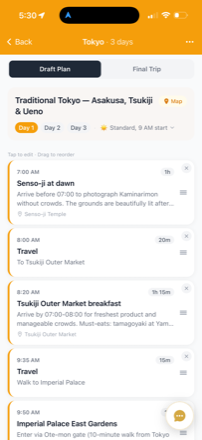
Get this guide as a tappable itinerary — freeDay-by-day plan, audio tours, one-tap Google Maps
Plan My TripThe intersection of everything
The world’s busiest crossing, a 230-meter rooftop, and Tokyo’s best people-watching — all within a 10-minute walk.
Powered by ITINE
Day-by-day plan, audio tours, and one-tap Google Maps — completely free.
Destinations
Your Itinerary
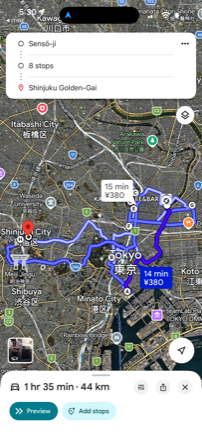
Google Maps
The world’s busiest pedestrian intersection — up to 3,000 people cross at each light change. Cross it from street level first to feel the rush, then view from above. The Starbucks overlooking it is always packed. Better viewpoints: Shibuya Sky or the Mag’s Park rooftop on the 109 building.
Open-air rooftop observation deck at 230 meters, on top of Shibuya Scramble Square. Unobstructed 360-degree views — Mt. Fuji visible on clear days. The outdoor "sky edge" section is genuinely thrilling. Budget 60–75 minutes.
A rooftop park sitting on top of a 4-story shopping complex. Green space, skate park, bouldering wall, and a terrace with views of the Shibuya skyline. Good for a breather between the chaos. The shops below have a curated, less-corporate feel than most malls.
The neon heart of Shibuya nightlife. Center-Gai is the main pedestrian street — chains, karaoke, and crowds. Dogenzaka is the hill behind it — bars, clubs, and love hotels. Walk it at night for the full effect. Louder and more chaotic than Shinjuku’s Golden Gai.
A design-forward department store reopened in 2019. The top-floor Nintendo store and Capcom store are worth visiting even if you’re not shopping. The art gallery on the upper floors shows interesting contemporary work. The basement food hall is excellent.
The famous statue of the loyal Akita dog who waited at the station for his deceased owner for nearly 10 years. It’s outside the station’s Hachiko Exit. A meeting point for locals, not really a destination — take a photo and move on.
Any single-origin pour-over. This Norwegian-Japanese coffee shop is one of Tokyo’s best third-wave spots. Transforms into a cocktail bar at night.
¥500–800
Sake (salmon) and umeboshi (pickled plum). Handmade to order at the counter, impossibly fresh. The niku-miso (meat miso) is the sleeper hit.
¥200–400 each
The classic tonkotsu ramen with your custom spice level, noodle firmness, and richness. You eat in individual booths — perfect for solo travelers. A great intro to Japanese ramen culture.
¥1,000–1,400
Salmon, engawa (flounder fin), and shrimp — order from the touchscreen and plates zoom to your seat on a bullet-train track. Fast, fun, and surprisingly good for the price.
¥110+ per plate
Point and choose — each tiny bar has its own personality. The alley is 40+ old-school drinking holes crammed into two narrow rows behind the station. Some are members-only, most welcome walk-ins.
¥1,000–3,000
JR Yamanote Line · 7 min
Marunouchi Line to Ginza, transfer Ginza Line · 20 min
— (you’re here)
Shibuya Station is being rebuilt through 2034 — exits and paths change frequently. Use Google Maps for real-time station navigation. Once outside, everything on this page is within a 10-minute walk except Fuglen and Onigiri Bongo (15 min).
Late afternoon (4–5 PM) arriving, Shibuya Sky at sunset (5:30–6:30 PM depending on season), then dinner and neon walk at night
Year-round — Shibuya doesn’t have a seasonal peak. The neon and energy are constant. Halloween (Oct 31) is legendary chaos if you’re into that.
Rush hour (7:30–9:30 AM, 5:30–7:30 PM) — the station is hellish. Friday and Saturday nights after 11 PM can get rowdy on Center-Gai.
2–4 hours — 15 min for the Scramble, 75 min for Shibuya Sky, 30 min for Miyashita Park, 60+ min for dinner and exploring. Can stretch to a full evening.
ELECTRIC PULSE — includes Shibuya