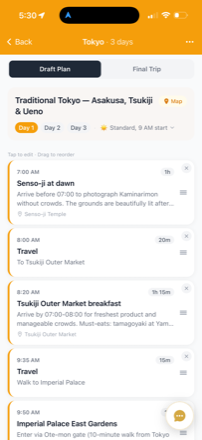
Get this guide as a tappable itinerary — freeDay-by-day plan, audio tours, one-tap Google Maps
Plan My TripHow many days do you have?
3-DAY PLAN · “THE CULTURE & TECH” · Add world-class museums and anime paradise
Powered by ITINE
Day-by-day plan, audio tours, and one-tap Google Maps — completely free.
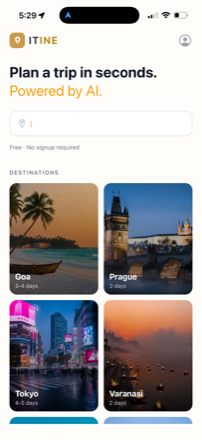
Destinations
Your Itinerary
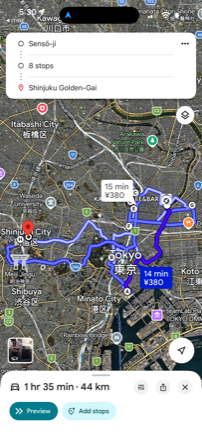
Google Maps
Digital Suica card & comfortable sneakers.
No exceptions.
Powered by ITINE
Day-by-day plan, audio tours, and one-tap Google Maps — completely free.
Destinations
Your Itinerary
Google Maps
Asakusa · Harajuku · Shibuya · Shinjuku
Ancient temples to neon canyons. The essential Tokyo contrast in one day.
5 stops · 6 food picks
Toyosu · Tsukiji · Ginza · Tokyo Station
Immersive digital art, the best street food market in Tokyo, and Ginza’s architectural runway.
4 stops · 6 food picks
Ueno · Akihabara · Yanaka · Kanda
World-class museums in the morning, anime paradise after lunch, and old Tokyo at golden hour.
4 stops · 6 food picks
Imperial Palace · Marunouchi · Shinjuku Gyoen
Add 1 day for Edo Castle gardens + the city’s best free sunset →
Kamakura · Hase · Enoshima
Add 2 days for a coastal day trip to Kamakura’s Great Buddha →
Nikko · Toshogu · Lake Chuzenji
Add 3 days for UNESCO golden shrines in Nikko’s mountain forests →
Shimokitazawa · Kichijoji · Nakano
Add 4 days to discover the vintage neighborhoods tourists never find →
Get a digital Suica on your phone (iPhone: Wallet app; Android: Google Pay). Covers all trains, subways, buses, and most konbini purchases. Load ¥3,000–5,000 to start.
JR Pass: Only worth it if you’re doing Kamakura + Nikko + other JR trips. For Tokyo-only, Suica is better and simpler. A 7-day JR Pass is ¥50,000 — do the math for your specific trips.
Airport: Narita → N’EX to Shinjuku/Shibuya (~60 min, ¥3,250). Haneda → Keikyu Line (~30 min, ¥500–700). Both accept Suica.
Get an eSIM before you land. Ubigi, Airalo, or Mobal all work in Japan. Pocket Wi-Fi is fading out — eSIM is cheaper, simpler, and you can’t leave it in the hotel. Budget ¥2,000–4,000 for 7 days of data.