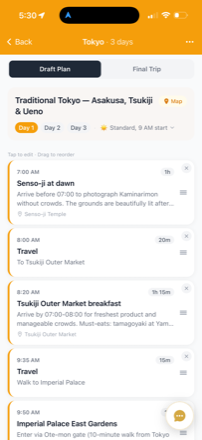
Get this guide as a tappable itinerary — freeDay-by-day plan, audio tours, one-tap Google Maps
Plan My TripSacred forest meets street-style chaos
A man-made forest planted in 1920, now home to 170 acres of mature woodland, and Tokyo’s wildest fashion street, separated by a single train station.
Powered by ITINE
Day-by-day plan, audio tours, and one-tap Google Maps — completely free.

Destinations
Your Itinerary
Google Maps
A Shinto shrine dedicated to Emperor Meiji, surrounded by 170 acres of forest that feels impossible in central Tokyo. The gravel path from Harajuku Station through towering torii gates is one of the most atmospheric walks in the city. The main shrine is simple and elegant.
A narrow 400-meter pedestrian street packed with crepe shops, kawaii fashion stores, vintage clothing, and sensory overload. It’s loud, crowded, and completely unique. The stores rotate frequently — what’s here today may be gone in 3 months.
A tree-lined backstreet running parallel to Omotesando, connecting Harajuku to Shibuya. This is where Tokyo’s fashion-forward crowd shops — independent designers, curated vintage, sneaker boutiques, and concept stores. Much calmer than Takeshita.
Tokyo’s Champs-Élysées — a wide, tree-lined boulevard with architectural flagships from every luxury brand. Even if you’re not shopping, the buildings themselves are worth seeing: Tadao Ando’s Omotesando Hills, Toyo Ito’s Tod’s building, and the honeycomb-like Prada store.
A free gallery covered in murals where any artist can rent wall space and exhibit. It changes constantly and is always surprising. Across the street from Takeshita but completely different in energy.
A flea market held on the 1st and 4th Sunday of each month in the grounds of Togo Shrine. Vintage kimono, ceramics, antiques, and vinyl records. One of the best markets in Tokyo.
Yuzu shio ramen — a light, citrus-scented chicken broth that’s completely different from heavy tonkotsu. The signature dish that made them famous.
¥1,000–1,400
The pan-fried gyoza (one plate is 6 pieces). Crispy on the bottom, juicy inside. Order multiple plates — you’ll want them.
¥600–1,000
Strawberry whipped cream pancakes — a mountain of cream that’s become an Instagram landmark. Tastes as good as it looks.
¥1,200–1,800
Whatever’s seasonal. Fresh produce, artisan bread, natural wine, craft coffee — all from small Japanese producers. Saturday and Sunday only.
¥500–1,500
Seafood mix okonomiyaki — you cook it yourself on the table griddle. Fun experience, good food, tourist-friendly with English menus.
¥900–1,400
JR Yamanote Line, 2 stops · 5 min
Chiyoda Line to Meiji-jingumae · 20 min
JR Yamanote Line, 1 stop · 3 min (or walk Cat Street, 15 min)
Everything is walkable. Meiji Jingu entrance is directly next to Harajuku Station. Takeshita Street entrance is across the road. Omotesando starts a 5-minute walk south. Cat Street runs parallel and connects to Shibuya — you can walk to Shibuya in 15 minutes without taking a train.
Morning (9–10 AM) for Meiji Jingu when it’s peaceful, then hit Takeshita and Cat Street mid-morning before the crowds peak
November–December when the Jingu Gaien ginkgo avenue turns golden. Also great during fashion weeks (March, October) when the street style is at its wildest
Sunday afternoon — Takeshita Street becomes a sardine can. Weekdays are dramatically calmer
2–4 hours — 45 min for Meiji Jingu, 30–60 min for Takeshita, 30–60 min for Cat Street/Omotesando. Can easily fill a half-day if you’re into fashion and shopping
ELECTRIC PULSE — includes Harajuku & Omotesando