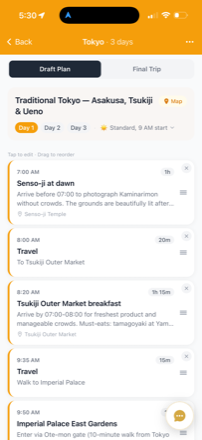
Get this guide as a tappable itinerary — freeDay-by-day plan, audio tours, one-tap Google Maps
Plan My TripWhere Tokyo dresses up and eats raw
Tokyo’s best street food market and its most elegant shopping boulevard, a 10-minute walk apart.
Powered by ITINE
Day-by-day plan, audio tours, and one-tap Google Maps — completely free.

Destinations
Your Itinerary
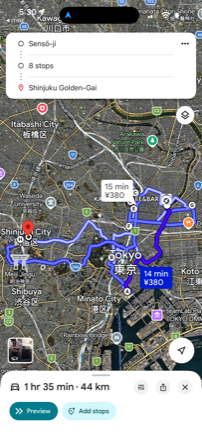
Google Maps
400+ stalls and small restaurants packed into narrow lanes. This is NOT where the tuna auctions happen (that moved to Toyosu years ago), but the outer market is thriving and arguably better for tourists. Go hungry — the whole point is eating your way through.
A luxury shopping complex with a stunning free rooftop garden. The garden features panoramic views (the Kusama art installation is in the atrium below). It’s a hidden quiet spot above one of Tokyo’s busiest shopping districts. The basement food hall is excellent.
Japan’s most famous kabuki theater. The ornate facade alone is worth photographing. Single-act tickets (¥1,000–2,000) let you watch one 30–60 minute act from the upper gallery without committing to a full 4-hour show. A great way to experience traditional Japanese theater.
The world’s biggest Uniqlo. Japan-exclusive items, collaborations, and limited editions are on the upper floors. The UT (graphic tee) floor has designs you won’t find outside Japan. Tax-free for tourists with passport.
Ginza’s main boulevards are an open-air museum of contemporary architecture. Hermès (glass bricks by Renzo Piano), Mikimoto (organic white curves), Swarovski (crystal façade), Cartier (mesh screen), and the De Beers building. Free to admire from the street.
Where the famous tuna auctions moved from Tsukiji. A viewing gallery lets you watch the auctions from above through glass walls. The market itself has a restaurant floor with some of the freshest sushi in Tokyo. Much more modern and sterile than Tsukiji.
Tamago on a stick — the iconic Tsukiji market snack. A thick, sweet Japanese omelette on a wooden skewer. The line moves fast.
¥100–200
The omakase (chef’s choice) set. Fish is absurdly fresh — the quality-to-price ratio is among the best in Tokyo. Shorter queue than the legendary Sushi Dai, equally good.
¥3,000–5,000
The wagyu steak lunch set — Ginza-quality wagyu at a lunch-set price. The meat is seared in front of you on a teppan. A splurge, but worth it.
¥5,000 (lunch set)
Hand-drip coffee in a china cup, served with old-world elegance. This is a classic Ginza kissaten — the atmosphere is the point. Velvet chairs, dark wood, no Wi-Fi, no laptops.
¥800–1,200
Tori paitan (creamy chicken broth) ramen. Michelin Bib Gourmand rated — the broth is silky, rich, and completely different from standard tonkotsu. One of Ginza’s best-kept secrets.
¥1,000–1,300
Fresh uni (sea urchin) cups (¥500–800), grilled scallops (¥500), tuna skewers (¥300), and fresh strawberries. Eat standing, move to the next stall. This is how Tsukiji works.
¥500–1,500
Marunouchi Line to Ginza · 20 min
Marunouchi Line, 1 stop · 3 min (or 10-min walk)
Ginza Line direct · 15 min
Tsukiji to Ginza is a 10-minute walk. They’re technically separate neighborhoods but practically adjacent. Start at Tsukiji in the morning (food), walk to Ginza in the afternoon (architecture and shopping). Tokyo Station is also walkable from Ginza in 15 minutes through Marunouchi.
Morning for Tsukiji (arrive 10–11 AM for the full market), afternoon for Ginza architecture walk, evening for illuminated façades and Kabuki-za
Year-round. Tsukiji is best in cooler months when fish is freshest. Ginza is pleasant in autumn and spring. On Sundays, Chuo-dori is closed to cars and becomes a pedestrian boulevard.
Tsukiji after 2 PM (stalls start closing). Tuesday and Wednesday (some Tsukiji vendors take these days off). Ginza is dead on Monday mornings.
3–4 hours — 60–90 min for Tsukiji eating, 10-min walk to Ginza, 60–90 min for Ginza architecture + shopping. Add 60 min if doing Kabuki-za single act.
OLD WORLD ZEN — includes Ginza & Tsukiji