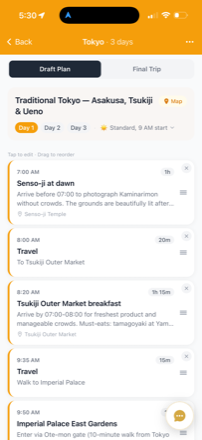
Get this guide as a tappable itinerary — freeDay-by-day plan, audio tours, one-tap Google Maps
Plan My TripOld Tokyo at its most photogenic
Thunder gates, incense smoke, and the best street food stalls in the city.
Powered by ITINE
Day-by-day plan, audio tours, and one-tap Google Maps — completely free.
Destinations
Your Itinerary
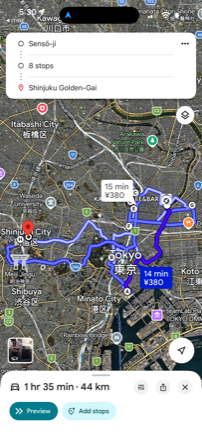
Google Maps
Tokyo’s oldest and most visited temple. The massive Kaminarimon (Thunder Gate) with its red lantern is the iconic photo. Walk through Nakamise-dori shopping street to the main hall. The incense hall (jokoro) is worth a stop — locals fan the smoke over themselves for good luck.
250 meters of traditional shops and stalls leading to Senso-ji. Souvenirs, snacks, and handcrafted goods. The shops on the parallel back streets (denpoin-dori) are less touristy and often better quality.
A narrow street lined with open-air izakayas just west of Senso-ji. Named after the beer-like drink Hoppy. This is where locals actually eat and drink — a stark contrast to the tourist-heavy temple area. Best in the late afternoon when the stalls fire up.
A striking 8-story building designed by Kengo Kuma, directly across from Kaminarimon. The free observation deck on the top floor gives you a perfect aerial view of Nakamise-dori and Senso-ji. One of Tokyo’s best-kept free viewpoints.
Walk along the Sumida River from Asakusa for views of Tokyo Skytree. The pedestrian bridge connecting Asakusa to Tokyo Skytree Town is a 15-minute walk with great photo angles.
A 10-minute walk from Senso-ji, this 800-meter street is where Tokyo’s restaurants buy their supplies. Famous for the incredibly realistic plastic food samples (shokuhin sampuru). You can buy miniature versions as souvenirs or take a workshop to make your own.
The house monjayaki — Tokyo’s answer to okonomiyaki. You cook it yourself on the griddle at your table.
¥800–1,200
Thick-cut shokupan toast with butter. Pelican has been baking bread since 1942 — their shokupan is legendary.
¥500–900
The standard gyukatsu set — you sear the rare beef on a hot stone at your table. Crispy outside, pink inside.
¥1,500–2,000
The tendon (tempura rice bowl) — a massive shrimp tempura draped over rice with a dark, savory sauce. The portion is enormous.
¥1,500–2,500
Level 7 matcha ice cream — the world’s strongest matcha gelato. They have 7 levels of matcha intensity. Level 4 is perfect for most people.
¥370–500
Zaru soba (cold soba with dipping sauce). One of Tokyo’s classic soba houses — the noodles are made fresh.
¥800–1,300
Marunouchi Line to Ginza, transfer Ginza Line · 30 min
Marunouchi Line to Ginza, transfer Ginza Line · 20 min
Ginza Line direct · 30 min
Asakusa is very walkable. Everything on this page is within a 15-minute walk of Asakusa Station. Kappabashi is the farthest at 10 minutes. Wear comfortable shoes — the temple grounds and shopping streets are all on foot.
Early morning (before 9:30 AM) for Senso-ji without crowds, or late afternoon (4–6 PM) for Hoppy Street drinks and a golden-hour walk
Cherry blossom season (late March–early April) when the temple grounds are stunning, or New Year (Jan 1–3) for the traditional hatsumode experience
Weekend midday (11 AM–3 PM) — Nakamise-dori becomes sardine-can packed and the temple area loses its atmosphere
2–3 hours — 60–90 min for Senso-ji + Nakamise, 30 min for Kappabashi if interested, 60+ min for Hoppy Street if eating/drinking
ELECTRIC PULSE — includes Asakusa