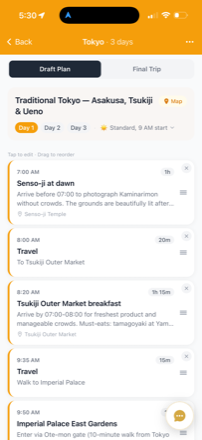
Get this guide as a tappable itinerary — freeDay-by-day plan, audio tours, one-tap Google Maps
Plan My TripEverything you need to know before you land
Powered by ITINE
Day-by-day plan, audio tours, and one-tap Google Maps — completely free.
Destinations
Your Itinerary
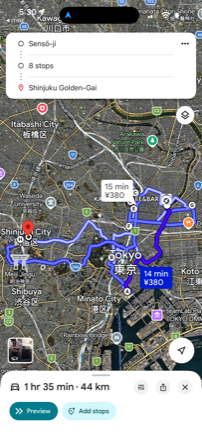
Google Maps
Do these before you board your flight and you’ll hit the ground running. Skip them and you’ll spend your first day in Tokyo fumbling with logistics instead of eating ramen.
Tokyo doesn’t work like other cities. There’s no single “downtown.” The city is a constellation of neighborhoods, each with its own personality, energy, and vibe. Shibuya is youth culture and nightlife. Asakusa is old Tokyo temples. Shinjuku is neon chaos. Ginza is money. Yanaka is the village that time forgot.
You don’t “see Tokyo” — you see neighborhoods. Plan each day around one or two adjacent neighborhoods rather than bouncing across the city. This is the single most important planning principle.
Trains stop at midnight. The last trains on most lines leave between 23:30 and 00:30. If you miss the last train, your options are: taxi (expensive), manga cafe or capsule hotel (cheap, interesting), or walk (Tokyo is extremely safe at night). Plan accordingly.
Tokyo is the safest major city on Earth. You can walk anywhere at any hour. Women walk alone at 3 AM. People leave laptops on cafe tables to use the bathroom. Lost wallets get returned with all the cash inside. Your biggest physical danger is bicycles on sidewalks.
English signage is excellent on transit but spotty in restaurants and residential areas. All train stations have English signs. Most metro announcements are bilingual. But the izakaya in the alley behind the station? That menu is in Japanese only. Google Translate’s camera mode is your best friend here.
Konbini (convenience stores) are lifelines. 7-Eleven, Lawson, and FamilyMart are on every block and they are not American gas station convenience stores. They sell genuinely good food, have ATMs that accept foreign cards, sell event tickets, offer package shipping, and have clean bathrooms. You will visit one multiple times per day.
The #1 mistake. Tokyo rewards depth over breadth. Two neighborhoods explored fully beats five neighborhoods rushed through. Build in wandering time. The best discoveries happen when you’re not chasing a checklist.
Tourists think konbini food is beneath them. It’s not. 7-Eleven’s egg sandwich is a cult classic. Lawson’s karaage-kun is beloved nationwide. FamilyMart’s onigiri is someone’s comfort food. At least one meal a day should come from a konbini.
Shibuya Sky, teamLab, Ghibli Museum, and popular restaurants fill up days or weeks ahead. You don’t need to schedule every minute, but the big-ticket items need advance booking. Do this before you fly.
Tokyo taxis are clean, safe, and extremely expensive. A 15-minute ride costs ¥2,000–¥4,000. The train system goes everywhere, runs every 3–5 minutes, and costs ¥150–¥300. Only use taxis after midnight when trains stop.
Sushi is one genre in a universe of Japanese cuisine. Ramen, tsukemen, tonkatsu, gyukatsu, tempura, udon, soba, okonomiyaki, yakitori, izakaya small plates, kissaten (retro cafes), wagashi (sweets). You’d need a month to scratch the surface.
Shinjuku or Shibuya are the best bases. They’re central on the Yamanote line, full of restaurants, and have the most transport options. Staying in Odaiba, Roppongi, or a suburb might save money but will cost you 30–60 minutes of commuting each way every day.
Credit card acceptance has improved but many ramen shops, izakayas, shrines, and market stalls are still cash only. Carry ¥10,000–¥20,000 at all times. Refill at any 7-Eleven ATM.
There’s no wrong answer, but different trip lengths unlock different layers of the city. Here’s what each duration gives you.
Shibuya Crossing, Meiji Shrine, Harajuku, Shinjuku at night, one incredible meal. You’ll barely scratch the surface but you’ll understand what makes Tokyo electric. Best for stopovers or Japan trip samplers.
Add Asakusa’s temples, Ueno’s museums, Akihabara’s chaos, and the Imperial Palace gardens. This is where Tokyo starts to feel like a real place, not just a highlight reel. Most first-timers should aim for this.
Now you can add day trips: Kamakura’s Great Buddha, Enoshima’s coastal walks, or Mt. Takao’s shrines. You also have time for Yanaka’s old-town charm and the neighborhoods tourists miss.
The full itinerary. Every neighborhood, a day trip, the hidden spots, and enough unplanned time to just wander. This is how you go from tourist to temporary local. You’ll leave already planning your return.
Japan runs on consideration. The culture is built around not inconveniencing others. You don’t need to be perfect — people are unfailingly kind to tourists who make an effort. These basics will get you most of the way there.
A slight bow (15°) is the default greeting. Deeper bows show more respect. You don’t need to bow as deeply as Japanese people do — a head nod with a slight forward lean is perfect for tourists. Skip the handshake unless they offer first.
Japanese people queue for everything: trains, restaurants, elevators, crosswalks. Never cut a line. Even if there’s no visible line, people are probably waiting in order. Ask “Is this the line?” if unsure.
If you see a raised entrance (genkan) or a shoe rack, take your shoes off. This applies to traditional restaurants, temples, ryokans, fitting rooms, and some Airbnbs. Socks are fine. Bare feet are not ideal.
Trains are silent. Phone calls on trains are a social crime. Speaking loudly in public is conspicuous. This isn’t about being uptight — it’s about shared space. Match the volume of the people around you.
Tipping does not exist in Japan. Not at restaurants, not at hotels, not for taxi drivers. It can be confusing or mildly offensive. The price is the price. Excellent service is the baseline, not something to be bought.
Public trash cans barely exist in Tokyo. Carry a small bag for your garbage. You’ll find bins at konbini (for stuff you bought there) and at some station platforms. This is the #1 thing that surprises visitors.
Use an open hand (palm up) to gesture toward people, places, or things. Pointing with a finger is considered rude. When directing someone, use your whole hand to indicate direction. Staff in stores do this constantly — follow their lead.
If someone gives you a business card, receive it with both hands, read it carefully, and do not write on it or shove it in your pocket. Place it respectfully on the table during a meeting or in a card holder. This applies mostly to business contexts, but knowing it shows cultural awareness.