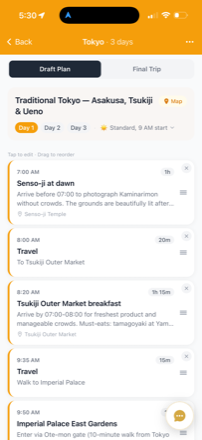
Get this guide as a tappable itinerary — freeDay-by-day plan, audio tours, one-tap Google Maps
Plan My Trip5 escapes ranked — which one deserves your day
Powered by ITINE
Day-by-day plan, audio tours, and one-tap Google Maps — completely free.
Destinations
Your Itinerary
Google Maps
| TRIP | TRAVEL TIME | ROUND-TRIP COST | BEST FOR | RATING |
|---|---|---|---|---|
| Kamakura | 60 min (JR) | ¥1,900 | Great Buddha, ocean temples, beach | ★★★★★ |
| Nikko | 2 hrs (Tobu) | ¥8,000 (All Nikko Pass) | UNESCO shrines, waterfalls, forests | ★★★★★ |
| Hakone | 90 min (Odakyu) | ¥7,100 (Freepass) | Hot springs, Mt. Fuji views, pirate ship | ★★★★ |
| Yokohama | 30 min (JR) | ¥940 | Chinatown, waterfront, ramen museum | ★★★ |
| Kawaguchiko | 2 hrs (bus) | ¥4,400 | Mt. Fuji up close, lake views | ★★★★ |
Kamakura was Japan’s political capital in the 13th century. Today it’s a compact seaside town with ancient temples, an over 770-year-old giant Buddha, and a coastline you can walk. It’s the most popular day trip from Tokyo for good reason — the combination of history, nature, and ocean is unmatched.
JR Yokosuka Line from Tokyo or Shinagawa Station, ~60 min. Suica works. JR Pass covers it. ~¥1,900 round trip.
Great Buddha at Kotoku-in (¥300, go inside for ¥50), Hase-dera Temple (ocean views from hillside), Tsurugaoka Hachimangu Shrine (grand steps, city views).
Shirasu-don (baby sardine rice bowl) — only available fresh here. Komachi-dori has purple sweet potato ice cream, senbei, and warabi mochi.
Choose either thorough Kamakura OR Kamakura morning + Enoshima island afternoon. Don’t try to rush everything.
Nikko is where the Tokugawa shoguns built their most extravagant shrine in a cryptomeria forest. It’s a UNESCO World Heritage site that looks like nothing else in Japan — gold leaf, intricate carvings, and towering cedar trees. Further into the mountains, Kegon Falls drops 97 meters into a gorge.
Tobu Limited Express from Asakusa, ~2 hours. NOT covered by JR Pass. Buy the All Nikko Pass (¥8,000) — covers round trip + unlimited local buses.
Toshogu Shrine (¥1,600) — the ‘see no evil’ monkeys, the sleeping cat, 200+ stone steps through forest. Shinkyo Bridge. Kegon Falls (optional, +40 min bus).
Yuba (tofu skin) is Nikko’s specialty. Try yuba soba, yuba tempura, or yuba in dashi broth at Nagomi Chaya near Shinkyo Bridge.
This is a long day — leave 7:30 AM, return 7–8 PM. Consider skipping Kegon Falls if fatigued. Toshogu alone justifies the trip.
Hakone is a volcanic hot spring region 90 minutes from Tokyo. The classic Hakone loop takes you through mountain railways, cable cars, a pirate ship on a crater lake, and — on clear days — a postcard view of Mt. Fuji. It’s the closest onsen experience to Tokyo.
Odakyu Romance Car from Shinjuku, ~90 min. NOT covered by JR Pass. Buy the Hakone Freepass (¥7,100) — 2-day pass covering all transport in Hakone + round trip from Shinjuku.
Hakone Open Air Museum (sculpture park), Owakudani volcanic valley (black eggs!), Lake Ashi pirate ship cruise, Mt. Fuji view from the lake.
Black eggs (kuro-tamago) at Owakudani — boiled in volcanic sulfur springs, shells turn black. Legend says each adds 7 years to your life. ¥500 for 4.
The Freepass is 2 days — consider an overnight ryokan stay with private onsen if budget allows. Day trip is doable but rushed.
Japan’s second-largest city is just 30 minutes from Tokyo. Yokohama has the country’s biggest Chinatown, a gorgeous waterfront, and the Cup Noodles Museum. It’s the easiest day trip — more of an afternoon trip, really.
JR from Tokyo or Shinagawa, ~30 min. Suica works. JR Pass covers it. ~¥940 round trip.
Yokohama Chinatown (600+ restaurants), Minato Mirai waterfront, Cup Noodles Museum (make your own cup, ¥500), Shin-Yokohama Ramen Museum (miniature 1950s street with 9 ramen shops).
Chinese steamed buns (nikuman) from the Chinatown stalls. Ramen at the Ramen Museum. Yokohama’s Chinatown is Japan’s largest and the food is legitimately excellent.
Best as a half-day. Combine with an afternoon in central Tokyo. Not worth a full day unless you’re specifically into the museums.
Kawaguchiko (Lake Kawaguchi) is the closest accessible base for Mt. Fuji views. You can’t easily climb Fuji on a day trip (climbing season is July–August only, and it’s a full overnight), but you can get incredibly close for photos, lake walks, and onsen with a Fuji backdrop.
Highway bus from Shinjuku Expressway Bus Terminal, ~2 hours. Or Fuji Excursion train (JR + Fujikyu, ~2 hours, limited daily departures). ~¥4,400 round trip (bus). Train ~¥4,500.
Lake Kawaguchiko shoreline walk, Chureito Pagoda (the iconic pagoda + Fuji photo — in Fujiyoshida, one train stop away), Fuji view onsen.
Hoto noodles — thick flat noodles in miso broth with vegetables. Fujiyoshida’s local specialty. Hearty and warming.
Fuji is only clearly visible ~40% of days. Best visibility: early morning, November–February (cold clear air). Check webcams before going.
Kamakura. Best all-around: history, nature, ocean, food. No bad weather risk. Works rain or shine.
Kamakura + Nikko. Coast and mountains. This is exactly what the 6-day itinerary does.
Hakone. Ideally overnight with a ryokan, but doable as a day trip. The Freepass makes logistics easy.
Kawaguchiko, but ONLY on a clear day. Hakone also has Fuji views with more backup activities if it’s cloudy.
Yokohama. 30 minutes, half-day, no planning needed. Chinatown + waterfront + Cup Noodles Museum.
The itinerary includes Kamakura (Day 5) and Nikko (Day 6) because they offer the strongest experiences for first-time visitors. Hakone and Kawaguchiko are excellent substitutes depending on your interests and weather.