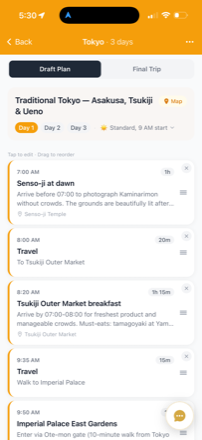
Get this guide as a tappable itinerary — freeDay-by-day plan, audio tours, one-tap Google Maps
Plan My TripThe modern megacity or the ancient capital — or both
Powered by ITINE
Day-by-day plan, audio tours, and one-tap Google Maps — completely free.
Destinations
Your Itinerary
Google Maps
Visit both. Seriously. They're complementary, not competing. Tokyo is the future — neon, tech, pop culture, skyscrapers, the world's best food city. Kyoto is the past — 2,000 temples and shrines, geisha districts, bamboo forests, tea ceremonies, zen gardens. Together they give you the full Japan experience.
If you genuinely can only pick one:
But really — the shinkansen is 2 hours 14 minutes. You can do both.
For detailed Kyoto planning, see our Kyoto itineraries — we cover 1 to 5 day plans organized by district to minimize transit time.
| Category | Tokyo | Kyoto |
|---|---|---|
| Vibe | Electric, chaotic, futuristic | Serene, traditional, aesthetic |
| Population | 14 million | 1.5 million |
| Food scene | World's most Michelin stars. Everything. | Kaiseki, matcha, tofu, Nishiki Market |
| Temples | A few (Senso-ji, Meiji Jingu) | 2,000+ (Kinkaku-ji, Fushimi Inari, Kiyomizu) |
| Nightlife | Golden Gai, Kabukicho, Shibuya, Roppongi | Gion bars, Pontocho alley (quiet by comparison) |
| Shopping | Harajuku, Akihabara, Ginza, Shibuya | Nishiki Market, Teramachi, antique shops |
| Nature | Parks, day trips to coast/mountains | Arashiyama bamboo, Philosopher's Path |
| Best for | First-timers, food lovers, pop culture, energy | Culture seekers, photographers, temple lovers, romance |
| Days needed | 3–5 (central) + 1–2 (day trips) | 3–4 (city) + 1 (Nara day trip) |
| Daily budget | ¥7,000–30,000+ | ¥6,000–25,000+ (slightly cheaper) |
| Getting there | 2 airports (Narita, Haneda) | Via Tokyo or Osaka (Kansai Airport) |
Tokyo hits you immediately. You step out of Shinjuku Station and 3.6 million people are flowing around you, neon signs are stacked 10 stories high, and a yakitori alley from 1946 is wedged between two skyscrapers. It's overwhelming, exhilarating, and exhausting — and that's just the first hour.
Kyoto is a slow exhale. You walk through a torii gate into a bamboo forest and the only sound is wind through the stalks. A geisha crosses a stone bridge at dusk. A temple garden has been raked into perfect circles for 500 years. It's meditative, beautiful, and occasionally boring — depending on your travel personality.
Neither is 'better Japan.' They're different Japans. The traveler who says 'I didn't like Kyoto' usually means 'I spent too many days there after Tokyo and the pace shift was jarring.' The fix isn't skipping Kyoto — it's pacing your trip correctly.
Tokyo is the world's greatest food city by objective metrics (more Michelin stars than any city on earth) and by sheer variety — ramen, sushi, tempura, yakitori, tonkatsu, gyudon, curry, izakaya, okonomiyaki, and every international cuisine. You could eat three meals a day for a month and never repeat a restaurant.
Kyoto's food is narrower but deeper. Kaiseki (multi-course Japanese haute cuisine) was born here. Kyoto's tofu is legendary — silky, fresh, prepared in ways you didn't know tofu could achieve. Matcha from Uji (just south of Kyoto) is the world's finest. Nishiki Market is smaller than Tsukiji but more curated.
The honest take: if food is your primary motivation, Tokyo wins on breadth and bang-for-yen. If you want refined, traditional Japanese cuisine as an art form, Kyoto wins.
| Category | Tokyo | Kyoto |
|---|---|---|
| Budget meal | ¥500–1,000 | ¥500–800 |
| Mid-range dinner | ¥2,000–5,000 | ¥2,000–4,000 |
| Transit/day | ¥800–1,500 | ¥500–1,000 (buses, bikes) |
| Accommodation (mid) | ¥10,000–20,000/night | ¥8,000–15,000/night |
| Top attraction | ¥2,000–3,800 | ¥400–600 (most temples) |
Kyoto is 10–20% cheaper than Tokyo for most categories. Temple entry fees are remarkably cheap (¥400–600). But if you do a ryokan stay with kaiseki dinner, that's ¥30,000–80,000/night — easily the most expensive single night of a Japan trip.
| Total Trip | Tokyo | Travel | Kyoto | Notes |
|---|---|---|---|---|
| 7 days | 4 days | 1 day | 2 days | Minimum Kyoto. Hit highlights only. |
| 10 days | 5 days | 1 day | 4 days | Sweet spot. Full Tokyo + proper Kyoto + Nara day trip. |
| 14 days | 5–6 days | 1 day | 4 days + 3 Osaka | The full experience. Add Osaka. |
The most common mistake: spending too many days in Kyoto. 3–4 days is the sweet spot. After that, temple fatigue is real — they start blending together. Tokyo has more variety to sustain 5–7 days without repetition.
Recommended split for 10 days:
Days 1–5: Tokyo (use the 5-day itinerary)
Day 6: Shinkansen to Kyoto (about 2h15m), afternoon in Gion
Days 7–9: Kyoto (temples, Arashiyama, Nara day trip)
Day 10: Kyoto → Kansai Airport, or continue to Osaka
Shinkansen (bullet train) is the only sensible option. Nozomi is fastest at about 2h15m. Hikari takes 2h40m but is covered by JR Pass. Kodama is slow (3h40m) — skip it.
| Train | Time | Cost | JR Pass |
|---|---|---|---|
| Nozomi | about 2h15m | ¥14,170 | ❌ Not covered |
| Hikari | 2h40m | ¥14,170 | ✅ Covered |
| Kodama | 3h40m | ¥14,170 | ✅ Covered |
Book: no reservation needed — just tap Suica/buy ticket and get on. Reserved seats recommended during peak seasons (Golden Week, Obon, New Year).
JR Pass math: A 7-day JR Pass is ¥50,000. Tokyo→Kyoto round trip on Hikari is ¥28,340. Add in-Tokyo JR rides (~¥3,000) and a Kamakura day trip (~¥1,900) = ¥33,240. Still under ¥50,000. The JR Pass only makes sense if you're also going to Osaka, Hiroshima, or doing multiple long-distance trips.