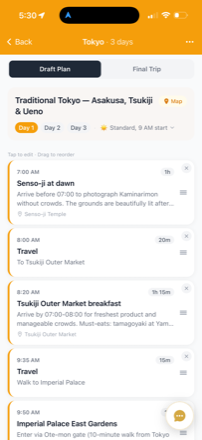
Get this guide as a tappable itinerary — freeDay-by-day plan, audio tours, one-tap Google Maps
Plan My TripTrains, cards, and surviving Shinjuku Station
Powered by ITINE
Day-by-day plan, audio tours, and one-tap Google Maps — completely free.
Destinations
Your Itinerary
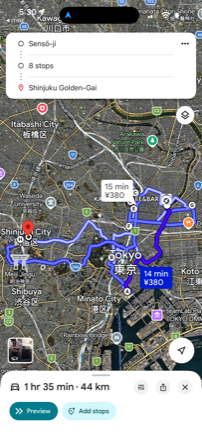
Google Maps
Forget paper tickets. Forget figuring out fare zones. Get a Suica card and tap through every gate in the city.
Suica is a rechargeable IC card that works on virtually every train, bus, and metro line in Tokyo (and most of Japan). You tap in, tap out, and the correct fare is deducted automatically. It also works at konbini, vending machines, coin lockers, and some restaurants.
As of 2024, physical Suica card sales resumed in March 2025, though Apple Wallet Suica remains the easiest option. Add a Mobile Suica to your iPhone or Apple Watch via the Wallet app. Android users can use Google Pay. You can charge it with a foreign credit card.
If you absolutely need a physical card, Welcome Suica cards (no deposit, 28-day expiry) are available at Narita and Haneda airports. But digital is better in every way.
Tokyo has 13 subway lines, dozens of JR lines, and multiple private railways. It looks like a bowl of noodles on the map. But for a week-long visit, you really only need to know five lines. Your Suica works on all of them.
| Line | Color | Key Stops | You’ll Use It For |
|---|---|---|---|
| JR Yamanote | Green | Shibuya, Shinjuku, Tokyo, Ueno, Akihabara | The circle line. Connects all major hubs. Your default. |
| Ginza Line | Orange | Shibuya, Omotesando, Ginza, Asakusa | Shibuya to Asakusa direct. The oldest subway in Asia. |
| Chuo Rapid | Red-Orange | Tokyo, Shinjuku, Kichijoji, Mt. Takao | East-west express. Also the line to Mt. Takao day trip. |
| Hanzomon Line | Purple | Shibuya, Omotesando, Otemachi, Oshiage | Shibuya to Tokyo Skytree. Runs parallel to Ginza Line but less crowded. |
| Chiyoda Line | Green (darker) | Meiji-jingumae, Omotesando, Otemachi, Sendagi, Nezu | Meiji Shrine access and connects to Odakyu line for Hakone. |
The Japan Rail Pass is legendary — and often a waste of money for Tokyo-only trips. A 7-day JR Pass costs ¥50,000 (as of 2024 pricing). To break even, you need to take at least one round-trip shinkansen (bullet train) ride, like Tokyo–Kyoto.
If you’re staying in Tokyo the whole time, the math almost never works. Here’s the breakdown:
| Trip | Normal Price | JR Pass Covers? | Verdict |
|---|---|---|---|
| Tokyo → Kyoto (round trip) | ¥27,500 | Yes | JR Pass saves ¥+. Worth it if combined with other trips. |
| Tokyo → Kamakura (round trip) | ¥1,900 | Yes | Savings: ¥1,900. Not enough alone to justify the pass. |
| Tokyo → Nikko (round trip) | ¥5,500 (JR portion) | Partially | JR covers only part. Tobu line is cheaper and direct. |
| Tokyo → Hakone (round trip) | ¥4,600 | Partially | JR to Odawara only. Hakone Free Pass is better value. |
| Daily Yamanote + JR rides | ¥500–¥1,000/day | Yes | 7 days = ¥3,500–¥7,000. Tiny fraction of pass cost. |
| Narita Express (round trip) | ¥6,500 | Yes | Nice bonus if you have the pass, but not worth buying one for this alone. |
Two airports serve Tokyo: Narita (60–90 min from central Tokyo) and Haneda (20–40 min). If you have a choice, fly into Haneda. It’s dramatically closer and the train connections are simpler.
| Route | Option | Time | Price | Best For |
|---|---|---|---|---|
| Narita → Tokyo | Narita Express (N’EX) | 60 min | ¥3,250 | Direct to Tokyo, Shibuya, or Shinjuku. Comfortable, reserved seats. |
| Narita → Tokyo | Skyliner | 41 min | ¥2,580 | Fastest option. Goes to Ueno/Nippori. Transfer to Yamanote from there. |
| Narita → Tokyo | Access Express | 80–90 min | ¥1,270 | Budget option. No reserved seats. Connects to Asakusa line directly. |
| Haneda → Tokyo | Tokyo Monorail | 13 min | ¥500 | To Hamamatsucho. Transfer to JR Yamanote. Quick and cheap. |
| Haneda → Tokyo | Keikyu Line | 20–30 min | ¥300–¥500 | Direct to Shinagawa, Shimbashi. Connects into subway system. |
Shinjuku Station serves 2.7 million passengers per day. It holds the Guinness record for the world’s busiest station. It has over 200 exits and connects 12 different rail lines across 5 different operators.
You will get lost. Everyone gets lost. The key is to not panic and follow these survival rules.
Every line has a color code. JR Yamanote is green. Marunouchi is red. When you’re overwhelmed by signs, just follow the color of the line you need. The colored signs will guide you to the right platform.
Exit names are often in Japanese only, but exit numbers are universal. Google Maps will tell you “Use Exit B7” — follow that number. It’s posted on yellow signs throughout the station.
Escalator etiquette: stand on the left in Tokyo (opposite of most countries), walk on the right. In Osaka it’s reversed. On stairs and corridors, keep to the left side of the flow. Stopping in a corridor is the cardinal sin.
If you’re completely disoriented underground, find stairs going up and surface. Once you’re at street level, reorient with Google Maps and re-enter the station through the correct entrance. It’s faster than wandering underground tunnels.
Four apps will save you more time than any guide ever could. Download these before you board your flight.
The single most important app in Tokyo. Real-time train schedules accurate to the minute, walking directions, station exit guidance, and even tells you which train car to board. Download offline maps for Tokyo before you leave home.
The backup to Google Maps and sometimes better for complex transfers. Shows platform numbers, transfer walking times, and fare breakdowns. The free version covers everything you need.
Your train card, convenience store payment, and vending machine tap card all in one. Set it as Express Transit so you don’t need to unlock your phone at gates. Reload in-app with a credit card.
The camera translation feature is magic. Point your phone at any Japanese menu, sign, or label and it translates in real-time via AR overlay. Download the Japanese language pack for offline use.