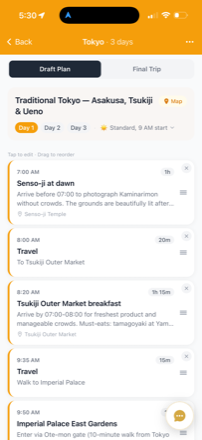
Get this guide as a tappable itinerary — freeDay-by-day plan, audio tours, one-tap Google Maps
Plan My TripDaily budgets from ¥7,000 to ¥30,000
Powered by ITINE
Day-by-day plan, audio tours, and one-tap Google Maps — completely free.
Destinations
Your Itinerary
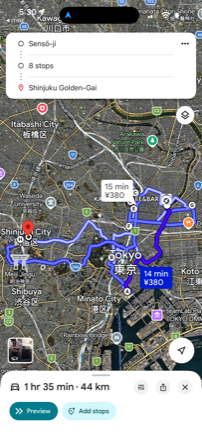
Google Maps
Three tiers, three very different experiences. The surprise is that even the budget tier lets you eat incredibly well and see everything that matters. Tokyo is not the expensive city people think it is — especially with the yen’s recent weakness against the dollar and euro.
| Category | Budget (¥7K) | Mid-Range (¥15K) | Splurge (¥30K+) |
|---|---|---|---|
| Food | ¥2,000–¥3,000 | ¥4,000–¥6,000 | ¥10,000–¥20,000 |
| Transport | ¥800–¥1,200 | ¥1,000–¥1,500 | ¥2,000–¥4,000 |
| Activities | ¥0–¥1,000 | ¥2,000–¥4,000 | ¥5,000–¥10,000 |
| Accommodation | ¥3,000–¥5,000 | ¥8,000–¥12,000 | ¥15,000–¥30,000 |
| Daily Total | ¥7,000–¥10,000 | ¥15,000–¥23,000 | ¥30,000–¥65,000 |
Budget (¥7,000–¥10,000/day): Konbini breakfasts, ramen or gyudon lunches, one sit-down dinner. Hostels or capsule hotels. Free shrines and parks. This is not suffering — this is how many Japanese people eat daily.
Mid-Range (¥15,000–¥23,000/day): A cafe breakfast, a proper lunch set, one memorable dinner. Business hotel or Airbnb. Paid attractions like teamLab or Shibuya Sky. The sweet spot for most travelers.
Splurge (¥30,000–¥65,000/day): Omakase sushi, cocktail bars, teppanyaki wagyu. Boutique hotel. Taxis when you feel like it. This is Tokyo at its finest, and honestly it’s still cheaper than an equivalent day in London or New York.
Food is where Tokyo punches way above its weight class. A bowl of ramen that would cost $18 in New York is ¥900 here. A lunch set at a Michelin-starred restaurant is ¥1,100–¥1,500. Konbini onigiri are ¥120–¥200. You can eat 3 meals a day for ¥2,000 without trying hard, or blow ¥20,000 on a single omakase. Both are valid.
Transport is cheap if you use trains. A typical day of sightseeing uses ¥800–¥1,500 on Suica. The Yamanote line (¥150–¥200 per ride) connects most neighborhoods. Only take taxis if you’re in a group of 3–4 late at night after trains stop (around midnight).
Activities range from free to expensive. Meiji Shrine, Senso-ji, Ueno Park, Yanaka, and most neighborhood walking is completely free. Paid attractions like teamLab Borderless (¥4,200), Shibuya Sky (¥2,200), and Tokyo Skytree (¥3,100) add up if you do several, but you don’t need to do all of them. Pick 2–3 paid attractions for the whole trip.
Accommodation is the biggest variable. Capsule hotels (¥3,000–¥5,000), business hotels (¥8,000–¥12,000), and boutique/luxury (¥15,000–¥50,000). Location matters more than class — a business hotel in Shinjuku beats a luxury hotel in a suburb.
A konbini coffee (¥150) + egg sandwich (¥250) + onigiri (¥150) = ¥550 breakfast. That’s $3.60 USD. It’s not sad — it’s what half of Tokyo does every morning.
The same restaurant that charges ¥5,000 at dinner might serve an ¥1,100 lunch set with the same kitchen. Teishoku (set meals) at lunch are Tokyo’s best-kept budget secret.
Skip Tokyo Skytree (¥3,100). The Tokyo Metropolitan Government Building in Shinjuku has a free observation deck at 202 meters with better views and zero lines. Open until 22:00 (last entry 21:30).
Spend over ¥5,000 at one store and you can get the 10% consumption tax refunded. Look for “Tax-Free” signs. Electronics shops in Akihabara, Don Quijote, and department stores all offer this.
Daiso, Seria, and Can Do are the Japanese dollar stores. Chopsticks, souvenirs, stationery, kitchen items, and travel accessories for ¥100 each. The Harajuku Daiso is multi-story and incredible.
Beyond trains, Suica works at konbini, vending machines, and many restaurants. Loading ¥5,000 and tracking your taps is the easiest way to monitor daily spending without carrying excess cash.
Shinjuku is the best base for most travelers. It’s the hub of the Yamanote line, has the most hotel options, and gives you the cheapest/fastest access to every neighborhood. You’ll save on transport and time every day.
Japan is still a heavily cash-based society, especially outside of department stores and large chains. The situation is improving — more places accept IC cards (Suica) and credit cards than five years ago — but you will absolutely encounter cash-only situations.
Ramen shops, small izakayas, market stalls, temple admission fees, coin lockers, and many independent restaurants only take cash. Some vending machines are cash-only too. If you’re doing a day in Yanaka, Tsukiji outer market, or bar-hopping in Golden Gai, you need physical yen.
How much to carry: ¥10,000–¥20,000 per day is comfortable. Keep it in a mix of ¥1,000 notes and coins. ¥10,000 notes can be hard to break at small establishments.
Where to get cash: 7-Eleven ATMs are everywhere and accept almost all foreign bank cards (Visa, Mastercard, Cirrus, Plus). Japan Post Bank ATMs also work well. Avoid currency exchange counters at the airport — the rate is always worse.
Credit cards: Visa and Mastercard are accepted at major retailers, chain restaurants, hotels, and department stores. Amex coverage is spottier. JCB (Japanese domestic brand) is widely accepted. Apple Pay with Suica is the most versatile option.